

Application scenario
The intelligent battery solution for rail transit inspection instruments adopts the SBS communication protocol and a smart fuel gauge to achieve precise remaining capacity management, along with a waterproof and shock-resistant structure.
Rail transit portable inspection instruments have strict requirements for capacity accuracy, communication protocols, and outdoor reliability. Traditional voltage estimation methods can have an error rate of up to 50%.
The solution employs an SBS intelligent battery management system, LED capacity display, and an aluminum alloy waterproof casing, supporting 14.8V multi-parallel and multi-series battery packs.
The following cases cover design parameters, structural requirements, and protection board solutions to facilitate host integration and evaluation.
Media assets





Related case materials
Rail Transit Inspection Instrument Intelligent Battery Design Solution
2020-04-07In recent years, with the rapid development of lithium batteries, many portable products use voltage measurements to estimate battery remaining capacity. However, the relationship between battery voltage and remaining capacity changes with discharge rate, temperature, and battery aging, leading to an error rate of up to 50%.
In recent years, with the rapid development of lithium batteries, many portable products use voltage measurements to estimate battery remaining capacity. However, the relationship between battery voltage and remaining capacity changes with discharge rate, temperature, and battery aging, leading to an error rate of up to 50%. As market demand for longer usage time increases, more precise solutions are needed in design. Using a smart fuel gauge IC to measure the charge input or consumed by the battery can provide more accurate battery capacity estimation across a wide range of application power levels.
I. Design Requirements for Inspection Instrument Intelligent Battery:
According to customer requirements and specifications, design an intelligent battery pack compatible with the host. Integrate a smart fuel gauge with communication protocol (SBS communication protocol) and battery safety protection features into your solution, enabling information sharing between the battery pack and host, achieving a rational, efficient, and safe battery management solution.
Specific design parameters are as follows:
1) Cell configuration: Use imported SANYO cells (18650-4S4P/8.8Ah/14.8V).
2) Structural design: Aesthetically pleasing appearance, with the overall battery meeting waterproof and shock-resistant requirements. For appearance, use a high-end aluminum alloy casing + aviation waterproof connector.
3) Circuit design: Precise capacity management + precise LED capacity display. Adopt an SBS intelligent battery management system design to effectively manage the remaining battery capacity in real time. The precise LED capacity display shows the remaining battery capacity as an accurate percentage via LED lights, providing efficient and intuitive user feedback.
II. Inspection Instrument Intelligent Battery Design Solution:
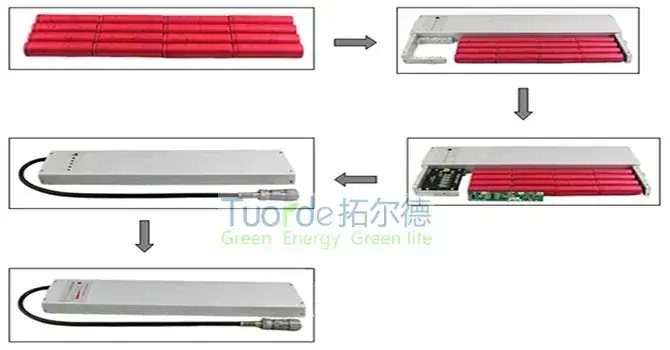
1) Aluminum alloy casing and aluminum bracket: Design an aesthetically pleasing aluminum alloy casing according to customer requirements, meeting waterproof and shock-resistant standards, as well as good heat dissipation under high current operation.
2) Smart fuel gauge protection board (PCM): Use an SBS intelligent battery management system, employing advanced capacity calculation principles to accurately calculate battery capacity in real time, and report capacity information to the host via SMBUS in real time. It also provides protection functions for rechargeable smart battery packs (typically lithium batteries). Due to the chemical properties of lithium batteries, protection against overcharge, over-discharge, short circuit, overcurrent, and overtemperature is required to avoid risks such as combustion or explosion.
3) LED capacity display board: The LED capacity indicator lights display the battery capacity calculated by the smart fuel gauge protection board in real time, in 20% increments, providing efficient and intuitive usage for customers.
4) Overcurrent protection device (PTC): Designed primarily for secondary protection. The PTC resettable fuse offers dual functions of overcurrent protection and automatic recovery. The PTC in battery products prevents high-temperature discharge and unsafe high currents.
5) UR18650-4S4P/10Ah/14.8V lithium battery pack (SANYO).
6) Special vacuum waterproof aviation connector: The battery uses a vacuum waterproof connection externally to meet customer waterproof requirements.
7) Partial circuit schematic diagram
8) Battery finished product assembly diagram
Rail Transit Inspection Instrument Intelligent Battery Design Solution
2020-03-24In recent years, with the rapid development of lithium batteries, many portable products use voltage measurements to estimate battery remaining capacity. However, the relationship between battery voltage and remaining capacity changes with discharge rate, temperature, and battery aging, leading to an error rate of up to 50%.
In recent years, with the rapid development of lithium batteries, many portable products use voltage measurements to estimate battery remaining capacity. However, the relationship between battery voltage and remaining capacity changes with discharge rate, temperature, and battery aging, leading to an error rate of up to 50%. As market demand for longer usage time increases, more precise solutions are needed in design. Using a smart fuel gauge IC to measure the charge input or consumed by the battery can provide more accurate battery capacity estimation across a wide range of application power levels.
I. Design Requirements for Inspection Instrument Intelligent Battery:
According to customer requirements and specifications, design an intelligent battery pack compatible with the host. Integrate a smart fuel gauge with communication protocol (SBS communication protocol) and battery safety protection features into your solution, enabling information sharing between the battery pack and host, ultimately achieving a rational, efficient, and safe battery management solution.
Specific design parameters are as follows:
1) Cell configuration: Use imported SANYO cells (18650-4S4P/8.8Ah/14.8V).
2) Structural design: Aesthetically pleasing appearance, with the overall battery meeting waterproof and shock-resistant requirements. For appearance, use a high-end aluminum alloy casing + aviation waterproof connector.
3) Circuit design: Precise capacity management + precise LED capacity display. Adopt an SBS intelligent battery management system design to effectively manage the remaining battery capacity in real time. The precise LED capacity display shows the remaining battery capacity as an accurate percentage via LED lights, providing efficient and intuitive user feedback.
II. Inspection Instrument Intelligent Battery Design Solution:
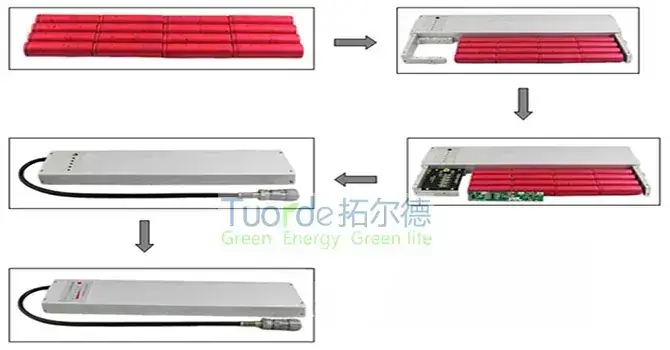
1) Aluminum alloy casing and aluminum bracket: Design an aesthetically pleasing aluminum alloy casing according to customer requirements, meeting waterproof and shock-resistant standards, as well as good heat dissipation under high current operation.
2) Smart fuel gauge protection board (PCM): Use an SBS intelligent battery management system, employing advanced capacity calculation principles to accurately calculate battery capacity in real time, and report capacity information to the host via SMBUS in real time. It also provides protection functions for rechargeable smart battery packs (typically lithium batteries). Due to the chemical properties of lithium batteries, protection against overcharge, over-discharge, short circuit, overcurrent, and overtemperature is required to avoid risks such as combustion or explosion.
3) LED capacity display board: The LED capacity indicator lights display the battery capacity calculated by the smart fuel gauge protection board in real time, in 20% increments, providing efficient and intuitive usage for customers.
4) Overcurrent protection device (PTC): Designed primarily for secondary protection. The PTC resettable fuse offers dual functions of overcurrent protection and automatic recovery. The PTC in battery products prevents high-temperature discharge and unsafe high currents.
5) UR18650-4S4P/10Ah/14.8V lithium battery pack (SANYO).
6) Special vacuum waterproof aviation connector: The battery uses a vacuum waterproof connection externally to meet customer waterproof requirements.
7) Partial circuit schematic diagram
8) Battery finished product assembly diagram
Rail Transit Batteries
Tuorde Energy
SBS
Tuorde Energy