

Application scenario
Robot battery systems cover applications such as floor scrubbers and service robots, supporting power communication, compact structure, and intelligent management of multi-series lithium batteries.
Service and cleaning robots require smart batteries that match the host structure, balancing communication, power metering, and safety protection.
The solution supports 22.2V–14.4V multi-specification packs, integrating fuel gauge ICs, hardware protection, and cell selection from brands like LG and Sanyo.
The following cases include two typical design solutions for floor scrubbers and intelligent cleaning robots.
Media assets




Related case materials
Battery Design Solution for Electric Floor Scrubber
2020-04-07Application host introduction: The push-type electric floor scrubber is a new eco-friendly product integrating the functions of a broom, dustpan, and trash bin. It features: 1. No energy required—push to activate all functions without bending; 2. Easy operation with 360-degree rotation, covering all indoor corners; energy-saving and quiet, suitable for hospitals, schools, malls, etc.; 3. Time-saving and efficient, cleaner than manual cleaning; 4. Durable and corrosion-resistant; 5. Lightweight and easy to transport, upright storage saves space; 6. Enclosed sweeping prevents dust, ensuring home hygiene and family health. Battery introduction: 1. Product function parameters: This scrubber battery integrates communication, power metering, hardware protection, temperature, voltage, and current sensing. 1) Lithium battery pack design requirements: LG ICR18650 MEI 2000mAh-6S/2Ah/22.2V/44.4Wh. 2) Input/output characteristics: Same port with auto-switching. 1. Input: 25.2V charger. 2. Output: 22.2V to power the host. 3) Power metering: Real-time accurate battery level via fuel gauge IC. 4) Protection board basics: 1. Overcharge protection: 4.28±0.05V; 2. Overcharge recovery: 4.15±0.05V; 3. Overdischarge protection: 2.60±0.10V; 4. Overdischarge recovery: 3.00±0.10V; 5. Continuous discharge current: 5A; 6. Overcurrent protection (22ms): 10A; 7. Charge over-temperature protection (recoverable): 65±5°C; 8. Discharge over-temperature protection (recoverable): 75±5°C; 9. Short circuit protection. 5) Cycle life: 300–500 cycles (national standard). 6) Dimensions: Based on actual battery housing. 2. Design solution: 1) Power metering and communication module: Fuel gauge IC calculates remaining capacity, enabling real-time communication with the host. 2) Hardware protection module: Protects the lithium battery pack from overcharge, overdischarge, short circuit, overcurrent, and over-temperature to prevent hazards. Uses hardware protection for enhanced safety. 3) Protection IC: Main protection chip for real-time monitoring of overcharge, overdischarge, overcurrent, and short circuit. 4) NTC: For temperature protection. Triggers at 65±5°C for charging and 75±5°C for discharging. 5) Cell selection: LG 18650 2000mAh/3.7V power cells. 6) MOSFET: Acts as a switch in the protection circuit. 7) Connector: Metal contact with the host. 8) Battery housing: High-grade plastic shell forming the complete battery module.
Application host introduction: The push-type electric floor scrubber is a new eco-friendly product integrating the functions of a broom, dustpan, and trash bin. It features: 1. No energy required—push to activate all functions without bending; 2. Easy operation with 360-degree rotation, covering all indoor corners; energy-saving and quiet, suitable for hospitals, schools, malls, etc.; 3. Time-saving and efficient, cleaner than manual cleaning; 4. Durable and corrosion-resistant; 5. Lightweight and easy to transport, upright storage saves space; 6. Enclosed sweeping prevents dust, ensuring home hygiene and family health. Battery introduction: 1. Product function parameters: This scrubber battery integrates communication, power metering, hardware protection, temperature, voltage, and current sensing. 1) Lithium battery pack design requirements: LG ICR18650 MEI 2000mAh-6S/2Ah/22.2V/44.4Wh. 2) Input/output characteristics: Same port with auto-switching. 1. Input: 25.2V charger. 2. Output: 22.2V to power the host. 3) Power metering: Real-time accurate battery level via fuel gauge IC. 4) Protection board basics: 1. Overcharge protection: 4.28±0.05V; 2. Overcharge recovery: 4.15±0.05V; 3. Overdischarge protection: 2.60±0.10V; 4. Overdischarge recovery: 3.00±0.10V; 5. Continuous discharge current: 5A; 6. Overcurrent protection (22ms): 10A; 7. Charge over-temperature protection (recoverable): 65±5°C; 8. Discharge over-temperature protection (recoverable): 75±5°C; 9. Short circuit protection. 5) Cycle life: 300–500 cycles (national standard). 6) Dimensions: Based on actual battery housing. 2. Design solution: 1) Power metering and communication module: Fuel gauge IC calculates remaining capacity, enabling real-time communication with the host. 2) Hardware protection module: Protects the lithium battery pack from overcharge, overdischarge, short circuit, overcurrent, and over-temperature to prevent hazards. Uses hardware protection for enhanced safety. 3) Protection IC: Main protection chip for real-time monitoring of overcharge, overdischarge, overcurrent, and short circuit. 4) NTC: For temperature protection. Triggers at 65±5°C for charging and 75±5°C for discharging. 5) Cell selection: LG 18650 2000mAh/3.7V power cells. 6) MOSFET: Acts as a switch in the protection circuit. 7) Connector: Metal contact with the host. 8) Battery housing: High-grade plastic shell forming the complete battery module.
Battery for Intelligent Electric Steam Floor Scrubber
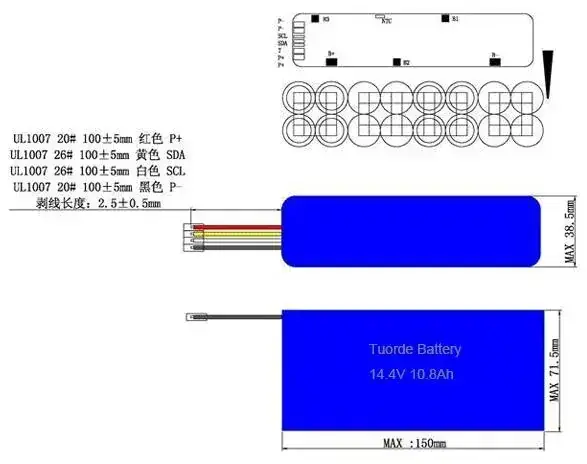
2020-04-07Introduction: (Keywords: robot battery) The supply of robots (industrial and service robots) is increasing across most industries. With rapid IT development, the world has entered a new era of intelligent robots. Supporting lithium batteries must meet the integration needs of mechanical structure, control drive systems, perception systems, and interaction systems, enhancing motion capability in complex environments and improving overall perception and decision-making. 1. Robot smart battery design requirements: Based on customer specifications, design a smart robot battery pack integrating a communication-protocol fuel gauge, lithium battery, and safety protection. This enables information sharing between the smart battery pack and host for efficient, safe battery management. The design focuses on perfect integration with the host, ensuring battery and system safety, and meeting design and certification regulations. Multiple internal protections prevent overcharge, overdischarge, and short circuits. 2. Robot smart battery design solution: UR18650FM Li-ion cell (SANYO). Pack specification: 18650-4S4P-10400mAh-14.4V. PCM: Protection circuit for rechargeable battery packs (typically lithium), providing overcharge, overdischarge, short circuit, overcurrent, and over-temperature protection to prevent fire or explosion. Protection IC: Main protection chip for real-time monitoring of overcharge, overdischarge, overcurrent, and short circuit, ensuring safe and stable operation. MOSFET: Acts as a switch in the protection circuit, maintaining stable voltage across the load. BQ40Z50-R1: Full-featured fuel gauge with ADC for voltage and temperature measurement, and ADC for current and charge sensing. It provides remaining capacity and run time to empty. The host can query this information to notify the user. Battery pack encapsulation: PVC. Robot smart battery design solution schematic.
Introduction: (Keywords: robot battery) The supply of robots (industrial and service robots) is increasing across most industries. With rapid IT development, the world has entered a new era of intelligent robots. Supporting lithium batteries must meet the integration needs of mechanical structure, control drive systems, perception systems, and interaction systems, enhancing motion capability in complex environments and improving overall perception and decision-making. 1. Robot smart battery design requirements: Based on customer specifications, design a smart robot battery pack integrating a communication-protocol fuel gauge, lithium battery, and safety protection. This enables information sharing between the smart battery pack and host for efficient, safe battery management. The design focuses on perfect integration with the host, ensuring battery and system safety, and meeting design and certification regulations. Multiple internal protections prevent overcharge, overdischarge, and short circuits. 2. Robot smart battery design solution: UR18650FM Li-ion cell (SANYO). Pack specification: 18650-4S4P-10400mAh-14.4V. PCM: Protection circuit for rechargeable battery packs (typically lithium), providing overcharge, overdischarge, short circuit, overcurrent, and over-temperature protection to prevent fire or explosion. Protection IC: Main protection chip for real-time monitoring of overcharge, overdischarge, overcurrent, and short circuit, ensuring safe and stable operation. MOSFET: Acts as a switch in the protection circuit, maintaining stable voltage across the load. BQ40Z50-R1: Full-featured fuel gauge with ADC for voltage and temperature measurement, and ADC for current and charge sensing. It provides remaining capacity and run time to empty. The host can query this information to notify the user. Battery pack encapsulation: PVC. Robot smart battery design solution schematic.
Robot Battery Systems
Tuorde Energy
Tuorde Energy
Tuorde Energy