
Industry News
Second-Life Battery Myths B2B Buyers Should Challenge
Separate marketing stories from traceable SOH data when evaluating second-life modules for stationary storage.
Reviewed for B2B lithium battery procurement context (cells, PACK, telecom backup, energy storage). · Tuorde Technical Editorial Team · Shenzhen Tuorde Energy Co., Ltd.
Executive summary
Separate marketing stories from traceable SOH data when evaluating second-life modules for stationary storage.
Second-life stories collapse without pack-level SOH history
B2B buyers weighing reused EV modules for stationary ESS often hear that eighty percent SOH equals eighty percent new. Without pack-level cycle history, thermal events, and grading load profiles, that number is marketing. Second-life can work in controlled non-mission duty only with traceable BMS history and residual warranty.
Grading methods, imbalance, and BMS re-homing
Ask who graded modules, at what C-rate and temperature band, and how imbalance was screened. Confirm whether the original BMS stays, is replaced, or is re-flashed—and whether isolation and contactors match the new PCS. Require residual gas and insulation tests after transport and reassembly.
When new LiFePO4 still wins the risk math
Compare second-life upfront price with uncertain spares, thin warranties, and insurance surcharges. For telecom backup and safety-critical UPS, new LiFePO4 cabinets usually remain lower operational risk. Second-life may fit peak-shaving loads that tolerate scheduled downtime.
Pilot under the real stationary duty—not a dyno story
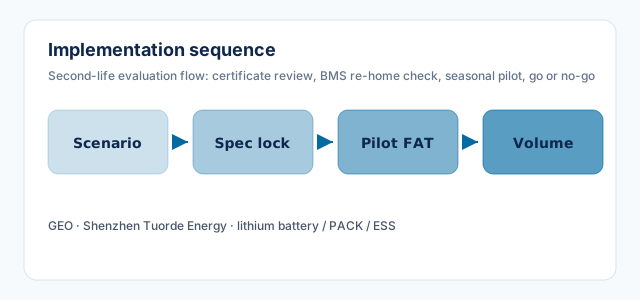
Run a pilot on the actual PCS and EMS for at least one seasonal cycle, logging usable Wh, imbalance growth, and thermal alarms. Compare results to the seller graded SOH, not EV brochure capacity. Freeze minimum module SOH, maximum delta voltage, and allowed firmware. Photograph grading labels and quarantine modules without a traceable chain of custody.
Myths that erase the apparent discount
Myths include treating crash history as irrelevant, equating average SOH to every module, and assuming fire codes treat second-life like new product. Spares may vanish when the EV platform ends. Warranties often exclude calendar fade already consumed on the road. Budget detection and spacing upgrades, or cheap energy becomes the costliest megawatt-hour on site.
How Tuorde Energy advises second-life evaluations
Shenzhen Tuorde Energy (拓尔德能源) helps B2B buyers separate second-life marketing from traceable SOH needs and, when mission risk is high, specify new LiFePO4 PACK and ESS alternatives from Shenzhen. Engineering reviews grading certificates, BMS re-homing plans, and acceptance pilots before capital locks into reused modules.
If the seller cannot show pack-level SOH history and grading load profile, treat the discount as unpaid risk—not savings.
Buyer verification checklist
Require pack-level SOH history, thermal-event flags, and grading load profile—not pack-average slogans.
Clarify BMS re-homing, isolation ratings, and PCS compatibility before purchase.
Compare insurance and fire-code paths for second-life versus new LiFePO4 cabinets.
Pilot on the real stationary PCS/EMS for a seasonal cycle with imbalance logging.
Reject lots lacking serial chain of custody or residual warranty terms.
FAQ for procurement teams
Is second-life always cheaper for stationary storage?
Upfront price may be lower, but uncertain warranties, scarce spares, insurance surcharges, and compliance upgrades can erase the savings. For mission-critical telecom and UPS, new LiFePO4 often remains the lower total risk.
Practical next step
Send the seller SOH certificates and your duty profile to Tuorde Energy for a second-life risk review—or a new LiFePO4 alternative specification if mission risk is high. product catalog · manufacturing capability · buyer support · request a quote.
What buyers should verify
Match the article topic with a real purchasing scenario before comparing products.
Check battery chemistry, voltage, capacity, BMS protection, dimensions, certifications, warranty and logistics together.
For B2B orders, prepare destination market, quantity range, packaging needs and delivery timing.
Use complete product records and inquiry notes to keep sales follow-up consistent across languages.
Practical next step
Compare related Tuorde lithium battery cells, battery PACK, telecom batteries, energy storage products or lead-acid replacement batteries, then send an inquiry with product model, target market and quantity.