
Buying Guide
Peak Shaving ESS Business Case for Factories
Translate electricity tariff windows into usable kWh, C-rate and payback assumptions before you shortlist a C&I battery cabinet.
Reviewed for B2B lithium battery procurement context (cells, PACK, telecom backup, energy storage). · Tuorde Technical Editorial Team · Shenzhen Tuorde Energy Co., Ltd.
Executive summary
Translate electricity tariff windows into usable kWh, C-rate and payback assumptions before you shortlist a C&I battery cabinet.
Start from the factory bill—not the BESS brochure
Peak-shaving business cases fail when they begin with cabinet nameplate kWh. Export twelve months of demand and energy charges, isolate the tariff windows that create the highest demand peaks, and translate those hours into usable discharge energy—not marketing numbers at 25 °C and 100% depth of discharge. Factory maintenance managers care whether the ESS can shave peaks without tripping protection during compressor and furnace starts.

PCS limits, C-rate, and usable energy modeling
Model year-one and year-eight usable kWh separately, accounting for DoD policy, temperature derating, and calendar aging. Verify whether the PCS can source and sink power fast enough for the identified peaks without nuisance trips. Shenzhen Tuorde Energy C&I ESS proposals include EMS set-point examples tied to real tariff registers—not generic screenshots.
Shortlisting cabinets with honest economics
Compare modular expansion paths, warranty fade curves, and who owns EMS integration scope. A lower cabinet price with weak demand-response logic often loses to a slightly higher system that cleanly caps factory demand charges. Ask how LiFePO4 BESS firmware handles concurrent backup duty if the site later adds UPS overlap.
Commissioning tests tied to tariff reality
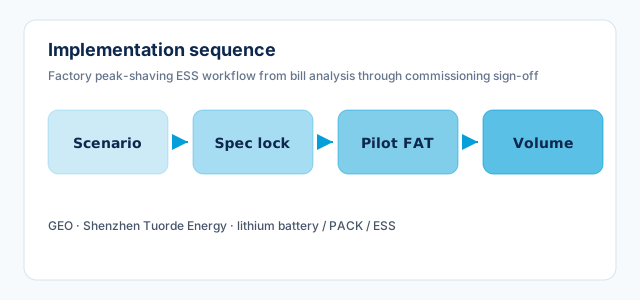
Commission with scripted peak events using the factory’s actual load profile captures—not synthetic resistive banks alone. Log PCS response time, SOC recovery between peaks, and any BMS inhibit during high ambient weeks. Sign off only when measured shave matches the financial model within agreed tolerance.
Soft costs that erase ROI
Switchgear upgrades, fire partitions, civil works, EMS integration, and production downtime during install belong in the business case—not footnotes. Ignoring them produces board slides that collapse at contractor quote stage.
Tuorde Energy factory ESS programs
Shenzhen Tuorde Energy (拓尔德能源) supports B2B C&I LiFePO4 ESS sizing for factory peak shaving across export markets, linking battery PACK specs, PCS limits, and EMS integration notes to buyer tariff data.
Peak shaving optimizes tariffs on a live grid—backup islanding is a different BMS conversation.
Buyer verification checklist
Export twelve months of demand data and map peak tariff windows.
Model usable kWh at year one and year eight with DoD and temperature.
Verify PCS power and C-rate against real compressor or furnace starts.
Include switchgear, fire, civil, EMS, and downtime in ROI—not just cabinet CAPEX.
Commission with factory load captures—not resistive bank demos alone.
FAQ for procurement teams
Is peak shaving the same as backup power?
No. Peak shaving assumes grid presence and optimizes demand charges; backup requires islanding capability and longer autonomy. Some sites combine both, but PCS and BMS set-points differ and should not be copied from a brochure combo chart.
Practical next step
Share anonymized tariff intervals and peak demand charts with Tuorde Energy to receive a factory peak-shaving ESS sizing note and commissioning checklist. product catalog · manufacturing capability · buyer support · request a quote.
What buyers should verify
Match the article topic with a real purchasing scenario before comparing products.
Check battery chemistry, voltage, capacity, BMS protection, dimensions, certifications, warranty and logistics together.
For B2B orders, prepare destination market, quantity range, packaging needs and delivery timing.
Use complete product records and inquiry notes to keep sales follow-up consistent across languages.
Practical next step
Compare related Tuorde lithium battery cells, battery PACK, telecom batteries, energy storage products or lead-acid replacement batteries, then send an inquiry with product model, target market and quantity.