
Technical Guide
Low-Temperature Charge Strategy for LiFePO4 Packs
How charge current, heaters and BMS inhibit logic should work when packs sit below freezing.
Reviewed for B2B lithium battery procurement context (cells, PACK, telecom backup, energy storage). · Tuorde Technical Editorial Team · Shenzhen Tuorde Energy Co., Ltd.
Executive summary
How charge current, heaters and BMS inhibit logic should work when packs sit below freezing.
Sub-zero charge without thermal policy invites plating risk
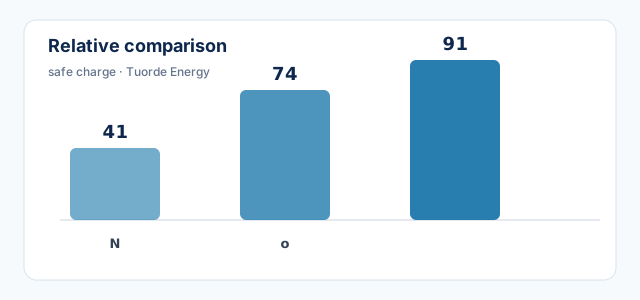
Low-temperature LiFePO4 charge strategy fails when packs sit below freezing while chargers still push full current. Without heater power budgets and BMS inhibit logic, lithium plating risk rises and warranty tickets arrive as unexplained capacity loss.
Heaters, inhibit thresholds, and power budgets
Engineering should define cell-temperature enable thresholds, heater source AC or DC, warm-up time before charge, and fallback current limits if heaters fail. Include heater load in black-start and genset sizing so the pack does not starve auxiliaries.
Heated SKUs versus parameter-only cold packs
Choose heated packs when sites routinely sit below freezing; otherwise require severe charge current limits and honest usable energy derating. Ask whether firmware bundles are climate-specific and whether spare modules share the same heater and inhibit policy.
Cold-chamber drills before winter release
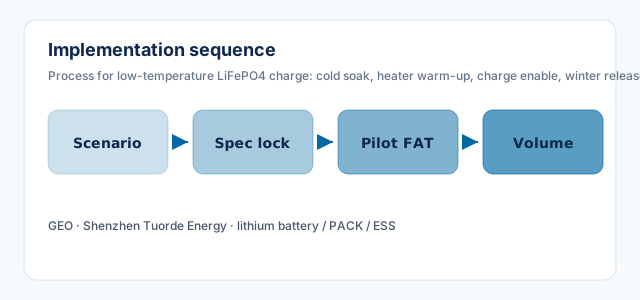
Accept with cold soak, warm-up timing, charge-enable logs, and heater fault alarm routing into EMS or NOC. Archive serial ranges, firmware hashes, and chamber temperature traces with the signed report. Freeze inhibit thresholds only after production-intent packs prove no charge below the agreed cell temperature floor.
Hidden heater loads and false pulse shortcuts
Ignoring heater kilowatts during black-start overloads gensets and aborts recovery. Treating charge aborts as nuisance alarms masks plating risk until SOH collapses. Pulse charging without dual-vendor approval creates an untested path that auditors will not accept after field failures.
Tuorde Energy cold-charge strategy support
Shenzhen Tuorde Energy (拓尔德能源) supports B2B LiFePO4 ESS and PACK buyers with heater-option reviews, cold-chamber acceptance scripts, and BMS inhibit maps aligned to export builds from Shenzhen. Engineering can align warm-up budgets and spare firmware policy before winter fleet release.
Below freezing, charge current is a thermal decision first—BMS inhibit and heater budgets must be written before winter.
Buyer verification checklist
Define cell-temperature charge-enable thresholds and heater fault alarms in the PO annex.
Budget heater power into black-start and genset sizing calculations.
Validate warm-up and charge enable in a cold chamber with the production harness.
Confirm climate-specific firmware bundles for heated versus non-heated spares.
Reject unapproved pulse-charge shortcuts without joint cell and BMS sign-off.
FAQ for procurement teams
Is pulse charging a safe shortcut for cold LiFePO4 packs?
Only if the cell vendor and BMS vendor jointly approve it for your chemistry and firmware. Otherwise prefer heater warm-up plus inhibit until cells clear the temperature floor, proven in a cold chamber with the production harness.
Practical next step
Share your lowest ambient, heater power availability, and BMS firmware revision with Tuorde Energy for a low-temperature LiFePO4 charge strategy and cold-chamber FAT checklist. product catalog · manufacturing capability · buyer support · request a quote.
What buyers should verify
Match the article topic with a real purchasing scenario before comparing products.
Check battery chemistry, voltage, capacity, BMS protection, dimensions, certifications, warranty and logistics together.
For B2B orders, prepare destination market, quantity range, packaging needs and delivery timing.
Use complete product records and inquiry notes to keep sales follow-up consistent across languages.
Practical next step
Compare related Tuorde lithium battery cells, battery PACK, telecom batteries, energy storage products or lead-acid replacement batteries, then send an inquiry with product model, target market and quantity.