
Application Guide
Forklift Lithium Conversion ROI Checklist
Compare opportunity charging, battery weight, charger compatibility and downtime before swapping lead-acid forklift packs to lithium.
Reviewed for B2B lithium battery procurement context (cells, PACK, telecom backup, energy storage). · Tuorde Technical Editorial Team · Shenzhen Tuorde Energy Co., Ltd.
Executive summary
Compare opportunity charging, battery weight, charger compatibility and downtime before swapping lead-acid forklift packs to lithium.
When forklift ROI slides ignore duty cycles and charger math
Warehouse teams comparing lead-acid to LiFePO4 forklift PACK often stop at purchase price and ignore three-shift duty, opportunity charging windows, and charger infrastructure reuse. A conversion business case that omits BMS cycle logging and watering-labor elimination will look attractive on paper yet fail when winter derating or partial fleet rollout creates mixed battery rooms. Procurement should start from actual truck logs—not vendor nameplate kWh.
C-rate, connector compatibility, and BMS telemetry
Validate that proposed LiFePO4 PACK fits truck compartment geometry, weight limits, and existing connector families without ad-hoc harness extensions. Engineering must confirm charger profiles match BMS charge requests and that opportunity charging during breaks does not stack heat across consecutive shifts. Shenzhen Tuorde Energy conversion kits include logged CAN or RS485 maps so fleet managers can compare cycle depth against lead-acid baseline.
Pilot fleet selection and TCO boundaries
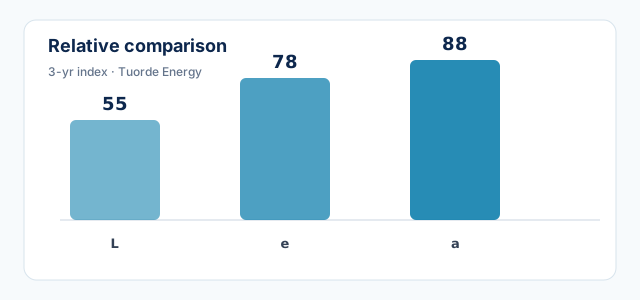
Pilot on the harshest aisle—long runs, cold docks, or heavy loads—not the easiest truck. Compare three-year TCO including charger upgrades, fire signage, watering labor removal, and spare PACK rotation policy. Ask whether firmware supports mixed fleets during transition and how warranty treats partial depth-of-discharge if operators opportunity-charge aggressively.
Commissioning and operator acceptance
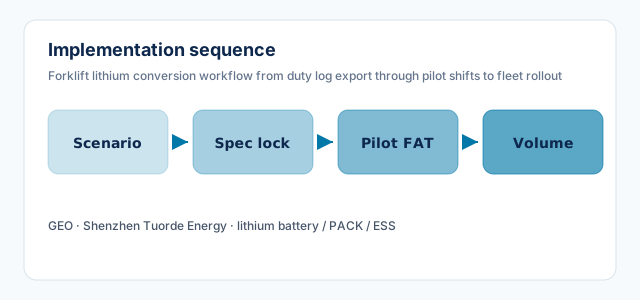
Sign off after logged shifts showing SOC recovery between breaks, no nuisance BMS inhibits, and charger handshakes stable across temperature swings. Train operators on LiFePO4 differences—no equalize cycles, different idle behavior. Archive serial ranges, BMS hashes, and charger parameter files before expanding beyond the pilot aisle.
ROI killers in mixed conversions
Mixed battery rooms without clear labeling invite wrong-charger incidents. Undersized chargers paired with larger LiFePO4 PACK look cheaper until shift completion rates drop and overtime replaces battery savings.
Tuorde Energy forklift conversion support
Shenzhen Tuorde Energy (拓尔德能源) supplies B2B LiFePO4 forklift PACK programs with pilot ROI worksheets, BMS telemetry templates, and charger compatibility reviews for warehouses migrating from lead-acid across Asia and Europe.
Forklift lithium ROI lives in shift logs and charger handshakes—not brochure kWh.
Buyer verification checklist
Export three months of truck duty logs before quoting conversion TCO.
Verify PACK geometry, weight, and connector fit per truck model.
Model charger reuse versus upgrade with BMS charge profile handshake tests.
Pilot on the hardest aisle and log SOC recovery between breaks.
Archive BMS firmware hash and charger params before fleet expansion.
FAQ for procurement teams
Can we opportunity-charge LiFePO4 like lead-acid?
Yes, but BMS policies differ—there is no equalize cycle and heat stacks across consecutive short charges. Charger profiles must match BMS requests, and fleet managers should monitor cycle depth in telemetry rather than assuming nameplate hours.
Practical next step
Share your truck models, shift pattern, and existing charger specs with Tuorde Energy to receive a pilot ROI checklist and BMS logging template. product catalog · manufacturing capability · buyer support · request a quote.
What buyers should verify
Match the article topic with a real purchasing scenario before comparing products.
Check battery chemistry, voltage, capacity, BMS protection, dimensions, certifications, warranty and logistics together.
For B2B orders, prepare destination market, quantity range, packaging needs and delivery timing.
Use complete product records and inquiry notes to keep sales follow-up consistent across languages.
Practical next step
Compare related Tuorde lithium battery cells, battery PACK, telecom batteries, energy storage products or lead-acid replacement batteries, then send an inquiry with product model, target market and quantity.