
Compliance Guide
Fire Safety Checklist for Container ESS Projects
Detection, suppression interfaces and spacing rules buyers should freeze with the EPC before FAT of a containerized BESS.
Reviewed for B2B lithium battery procurement context (cells, PACK, telecom backup, energy storage). · Tuorde Technical Editorial Team · Shenzhen Tuorde Energy Co., Ltd.
Executive summary
Detection, suppression interfaces and spacing rules buyers should freeze with the EPC before FAT of a containerized BESS.
Container ESS fire design is a project deliverable, not an accessory SKU
Treating fire protection as an accessory add-on leaves gaps at AHJ inspection: undefined detection zones, ventilation fighting suppression, and EPO paths that strand the PCS. Container ESS fire readiness must integrate detection, controlled ventilation or exhaust, and suppression interfaces before FAT—not after the box lands on a crowded pad.
Detection, ventilation, suppression, and code alignment
Map detector types and zones to battery geometry, including dust and HVAC false trips. Align ventilation or venting with the suppression agent so fans do not defeat concentration. Require a cause-and-effect matrix for BMS thermal signals, EMS trips, EPO, dampers, and fire-panel outputs. Cross-check NFPA ESS guidance and applicable IEC product standards on the same drawings.
Clarify OEM, fire vendor, and EPC ownership early
Choose packages where battery OEM, fire vendor, and EPC scopes are written with interface drawings—not verbal assumptions. Prefer published detector lists, agent quantities, and nozzle maintenance access inside the container. Ask how off-gas sensors interact with BMS inhibit and whether remote panels share protocol with site SCADA.
FAT and site drills before energization
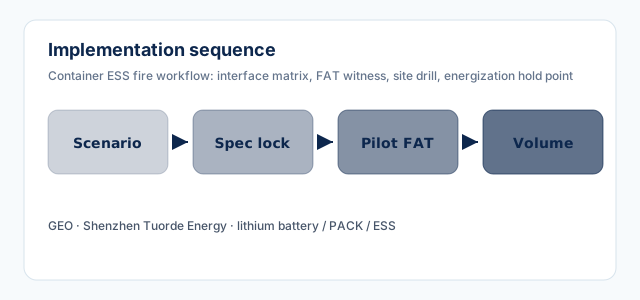
At FAT, witness detector tests, damper travel, EPO sequencing, and simulated BMS thermal alarms against the signed matrix. On site, confirm clearances, hydrant access, and signage before first charge. Run tabletop and physical drills with the local brigade where required. Archive as-built detection layouts, agent fill records, and panel revision hashes.
Conflicting systems and unowned maintenance
Costly failures include ventilation that keeps running during suppression, or detection that alarms without opening EPO. Unowned detector and agent maintenance fails at the worst moment. OEM fire kits may not match local AHJ reading of NFPA or national codes. Crowded pads that violate spacing force expensive moves after civil works. Gate fire readiness like electrical FAT.
How Tuorde Energy supports container ESS fire checklists
Shenzhen Tuorde Energy (拓尔德能源) supports B2B container ESS buyers with fire-interface checklists, cause-and-effect templates, and LiFePO4 PACK documentation for export projects from Shenzhen. Engineering helps align detection, ventilation, and suppression scopes with EPC and AHJ expectations before FAT and first energization.
Freeze detection, ventilation, and suppression ownership on one cause-and-effect matrix before the container leaves the factory.
Buyer verification checklist
Publish a signed cause-and-effect matrix for BMS, EMS, EPO, dampers, detection, and suppression.
Align ventilation or venting strategy so it does not defeat the chosen suppression agent.
Cross-check design against NFPA ESS guidance and applicable IEC product standards.
Witness FAT detector, damper, and EPO tests before shipment; drill with AHJ before energization.
Assign maintenance owners for detectors, agent pressure, and spare cylinders in the O&M plan.
FAQ for procurement teams
Who should own the container fire system—battery OEM or EPC?
Ownership must be explicit in the contract. Many projects split battery OEM interfaces from a fire-vendor package integrated by the EPC. Ambiguity surfaces during AHJ inspection; write interface drawings and test responsibilities before PO release.
Practical next step
Send your container layout, local code jurisdiction, and EPC scope split to Tuorde Energy for a container ESS fire-safety checklist before FAT. product catalog · manufacturing capability · buyer support · request a quote.
What buyers should verify
Match the article topic with a real purchasing scenario before comparing products.
Check battery chemistry, voltage, capacity, BMS protection, dimensions, certifications, warranty and logistics together.
For B2B orders, prepare destination market, quantity range, packaging needs and delivery timing.
Use complete product records and inquiry notes to keep sales follow-up consistent across languages.
Practical next step
Compare related Tuorde lithium battery cells, battery PACK, telecom batteries, energy storage products or lead-acid replacement batteries, then send an inquiry with product model, target market and quantity.