
Application Guide
Data Center UPS Lithium Migration Notes
Runtime, recharge window and fire compartment rules when replacing VRLA strings with LiFePO4 in UPS rooms.
Reviewed for B2B lithium battery procurement context (cells, PACK, telecom backup, energy storage). · Tuorde Technical Editorial Team · Shenzhen Tuorde Energy Co., Ltd.
Executive summary
Runtime, recharge window and fire compartment rules when replacing VRLA strings with LiFePO4 in UPS rooms.
UPS rooms punish lithium swaps that ignore recharge windows
Data center UPS lithium migration fails when teams treat LiFePO4 as a drop-in VRLA tray without mapping charger voltages, recharge windows, and ride-through events. Runtime at the actual kW step, not nameplate Ah, decides whether the next utility blip leaves the string half-empty.

Charger maps, runtime steps, and thermal layout
Engineering should map existing UPS charger setpoints to LiFePO4 charge profiles, including float elimination and BMS inhibit behavior after deep discharge. Model recharge time before the next ride-through and verify cabinet airflow against denser lithium trays.
Migration SKUs that respect room and code limits
Shortlist packs with published UPS-compatible charge curves, connector and clearance drawings, and spare firmware policy for dual-string rooms. Confirm whether footprint guarantees survive NFPA-oriented aisle and fire compartment constraints.
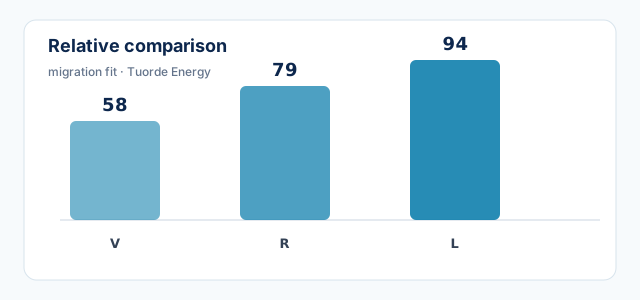
First-string soak before fleet cutover
Accept after measured runtime at the contracted kW step, recharge-window verification, and BMS alarm mapping into the facility NOC. Archive serial ranges, tray photos, and charger parameter screens with the signed migration report. Freeze cutover only when the first string completes the agreed soak without unexplained inhibit cycles or thermal alarms.
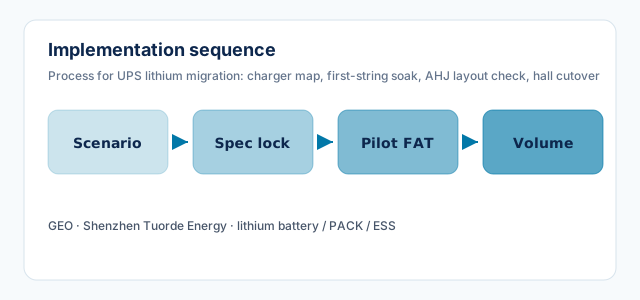
False footprint promises and fire-layout surprises
Same-footprint marketing often collapses when connector reach, working clearances, or fire barriers change the rack plan. Skipping AHJ alignment before ordering steel creates expensive redesigns. Treating lithium alarms as VRLA-style nuisance noise risks repeated inhibit and shortened SOH during the very events UPS rooms exist to survive.
Tuorde Energy support for UPS lithium cutovers
Shenzhen Tuorde Energy (拓尔德能源) supports B2B data-center and facility buyers migrating UPS rooms to LiFePO4 with charger-mapping worksheets, runtime acceptance scripts, and FAT photo archives aligned to export manufacturing from Shenzhen. Teams can align dual-string spare policy and NOC alarm codes before multi-hall cutover.
Migrate UPS lithium on measured kW runtime and recharge windows—not on tray photos that still assume VRLA float habits.
Buyer verification checklist
Map UPS charger voltages and float removal to the LiFePO4 BMS charge profile before PO.
Verify contracted kW runtime and recharge window on a production-intent string.
Align fire compartment, aisle clearance, and tray drawings with the AHJ early.
Log temperature and current on the first string for the agreed soak period.
Archive serials, charger screens, and NOC alarm mapping with the cutover report.
FAQ for procurement teams
Can LiFePO4 always keep the same UPS footprint as VRLA?
Not always. Lithium trays are denser, but connector reach, working clearances, and fire compartment rules can change the footprint. Confirm drawings with the AHJ and UPS vendor before ordering steel or promising a one-for-one tray swap.
Practical next step
Share your UPS model, charger setpoints, target kW runtime, and room layout with Tuorde Energy for a LiFePO4 migration worksheet and first-string soak checklist. product catalog · manufacturing capability · buyer support · request a quote.
What buyers should verify
Match the article topic with a real purchasing scenario before comparing products.
Check battery chemistry, voltage, capacity, BMS protection, dimensions, certifications, warranty and logistics together.
For B2B orders, prepare destination market, quantity range, packaging needs and delivery timing.
Use complete product records and inquiry notes to keep sales follow-up consistent across languages.
Practical next step
Compare related Tuorde lithium battery cells, battery PACK, telecom batteries, energy storage products or lead-acid replacement batteries, then send an inquiry with product model, target market and quantity.